For 107 years, the sandstone building at 300 N 2nd Street held people who didn't want to be there. It went up in 1872, served as the Clearfield County Jail until 1979, and sat around afterward looking like exactly what it was: a fortress with two turrets and a watchtower built to spot inmates trying to escape. If you grew up in Clearfield, you probably have a memory of it looking dark, closed off, a little grim.
This spring you could book a table there.
The Rock on the River had its grand opening weekend in May, with live music and a second-floor addition called The Warden Restaurant serving fine dining under chandeliers and arched windows. Downstairs, a speakeasy hides behind a secret door with an antique wall phone as the handle. The old solitary cells are being converted into a bridal suite and short-stay rooms. There's a distillery in the basement making whiskey under the name Doing Time. It is, by any measure, a strange and specific thing to have happened to a jail.
But the interesting part of this story isn't that a scary building became a nice restaurant. It's that this particular building landed in a downtown that had already spent several years rebuilding the block around it, on purpose, with public money that arrived well before the private money did. The Rock on the River isn't proof that downtown Clearfield is coming back. It's proof that it already had.
What Used to Scare Kids on Field Trips
Dr. Jeffrey Rice and Dr. Jeremy Rice, both of DuBois, bought the old jail and started the slow work of turning it into something else. Events and marketing manager Toni Frankenfield has said she kept nearly everything the renovation crews found inside, decades-old items like a hidden case of beer, old shoes, old clothing, and now many of those pieces are on display in the building itself. The distillery builds on earlier work started by Keith Billotte, a community member who began renovating the building and developing the distillery concept roughly five years ago before he passed away. Jeremy Rice took over that work about three years ago.
The new second-floor addition needed to match the original structure, so the builders sourced sandstone from Grampian, the same source used in 1872. Operations manager Ashley Bell put it simply when describing what visitors notice first:
"the nice sandstone that was originally sourced from Grampian, Pennsylvania"
That's not incidental detail. It's the difference between a renovation and a replica, and it's the kind of decision that only makes financial sense if you believe people will actually drive downtown to see it. The Rice family made that bet with private capital. What made the bet reasonable is a separate story that started years earlier, a few blocks away.
The Grant Money That Came Before the Restaurant Money
The Clearfield Revitalization Corporation runs the borough's Main Street program, and in May it was designated a 2026 Accredited Main Street America program for the second year running. That's not a participation award. Accreditation requires demonstrating actual results across community commitment, funding diversity, and preservation-based economic development, evaluated jointly by Main Street America and the Pennsylvania Downtown Center.
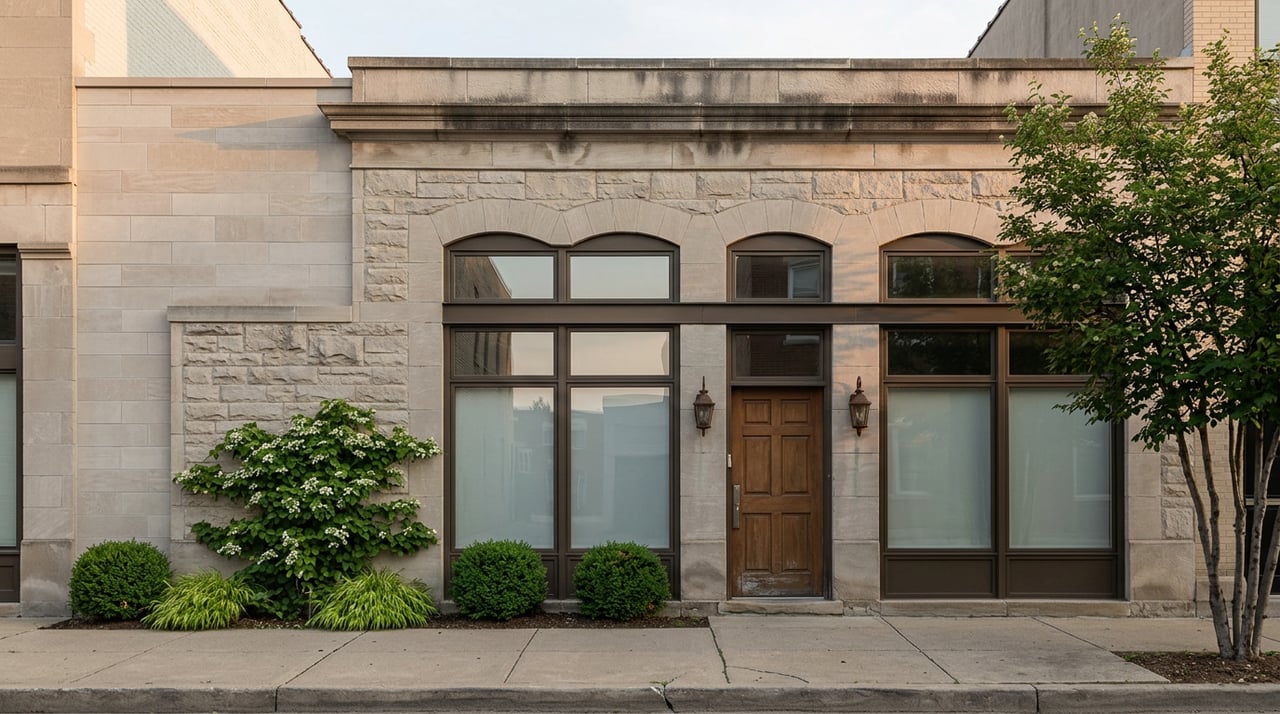
The mechanism behind that accreditation is a façade grant program, and the numbers are small on purpose. As of this spring, the CRC had committed $15,976.50 of its 2026 grant pool to property owners renovating storefronts downtown, with roughly $35,000 still unclaimed. One of the visible results already sits on Main Street: Spanky's Courthouse Café earned a 2025 state-level award from the Pennsylvania Downtown Center specifically for its façade renovation. That's the pattern. A few thousand dollars goes into a storefront, the block looks less tired, and the next investor who walks past has one fewer reason to say no.
Zoom out further and the scale changes entirely. Clearly Ahead Development, the county's economic development agency, has facilitated 32 brownfield redevelopment projects across Clearfield County since 1999, leveraging more than $388 million in private investment and helping retain more than 2,600 full-time jobs along the way. In April, Philadelphia Federal Reserve President Anna Paulson and Executive Vice President William Spaniel traveled to Clearfield specifically to meet with Clearly Ahead's leadership and tour the River's Landing building and the Riverwalk. The Fed doesn't send its president to look at a town that isn't doing something worth studying.
So the actual order of operations looks like this: small façade grants make individual storefronts look cared for, more than a quarter-century of brownfield redevelopment proves the county can absorb serious private capital without it going to waste, and only after both of those were established did a family decide a 154-year-old jail was worth turning into a restaurant instead of leaving as another empty downtown building.
Two Blocks Over, a Different Kind of Bet
Not every new business downtown required that much scaffolding. Gunpowder Grille opened this spring on E. Market Street, timed to coincide with Bob's Army & Navy's annual cabin fever sale weekend. The story behind it is smaller and more personal than the jail conversion, and that matters just as much.
Marissa and Bernie Ralston, Stephanie and Dan "Booie" Kline, and Andrew Reed opened the restaurant together. The connection started because the Ralstons' son works at Bob's Army & Navy, which led to a friendship with the Klines and Reed, and eventually to the group buying a building together when it came up for sale. The Ralstons already had food service experience through their Big Mamma's Sauces food truck and years of volunteering in the Houtzdale Moose Lodge kitchen, and Marissa previously owned Musket Cafe in Ramey. The menu runs on Big Mamma's sauces, and the decor leans on historical photos of what downtown Clearfield used to look like.
That's the second half of the pattern. It isn't only outside capital or grant-funded facade work bringing life back to Main Street. It's people who already had food service experience and existing local relationships deciding this was the moment to put both to use on the same handful of blocks as the jail conversion. Two very different investment logics, landing on the same eight-block grid, in the same year.
The Riverwalk Isn't Just a Backdrop Anymore
Clearfield's downtown sits along a mile of riverwalk connecting Raftsman Memorial Park with Upper and Lower Witmer Parks, and for years that space did what riverwalks in a lot of small towns do: it looked nice and mostly sat empty. That changed in 2023, when the CRC revived the Riverfront Festival after a 12-year hiatus.
This June's festival ran three days at Lower Witmer Park with a new Kids Zone, a Saturday fireworks show, and the return of the Flag Day ceremony after its own long absence. The Clearfield Kiwanis Club's Duck Derby sent 500 rubber ducks down the river from the Market Street Bridge to a finish line at the park, with prizes that included gift cards to Sherwood's Creamery, Scotto's Pizza, Clearfield Lanes, and the Ritz Theater. A separate Dice Run had boaters traveling downriver from the Curwensville Community Center to Lower Witmer Park with stops along the way.
What that list of prize sponsors actually shows is a downtown economy stitching itself back together in public. The festival isn't just an event the CRC throws. It's a mechanism that routes attention and dollars through a dozen small businesses that otherwise have no reason to appear in the same sentence.
The Momentum Didn't Stop When Summer Did
This past week alone made the case. On Thursday, August 27, PA CareerLink Clearfield County hosted Puppies in the Park at Lower Witmer Park, and the next night, Bike Night returned to E. Locust Street for the first time in eight years, with live music, concessions from Toda La Familia, and local pours from Prontocks and the Winery at Wilcox. Neither event is new. Both are old traditions that someone decided were worth reviving, which is the same instinct behind the façade grants and the jail conversion, just at a smaller scale.
The next marker on the calendar is the CRC's Fall Festival, set for Saturday, October 10. Board president Maria Lemmo has described it as bringing back something unique to the town after its own gap in recent years, the same language used around the Riverfront Festival's 2023 revival. That's not a coincidence. It's the same organization running the same playbook on a second event.
None of this required new institutions. It required old ones, coming back, on a schedule that keeps foot traffic moving through the same downtown blocks where the jail, the café, and the grille all sit within walking distance of each other.
The Part That Matters If You Live Here
None of this required a single big announcement. It required a façade grant program patient enough to fund a few thousand dollars at a time, a county development agency with more than a quarter-century of brownfield receipts to point to, and two sets of private owners willing to bet on buildings other people had written off. The jail is the story that gets the headline. The grant math and the brownfield count are the reason the headline was possible at all.
If you're already living in Clearfield, the practical version of all this is simple: the downtown you remember from ten years ago is not the downtown that exists right now, and the change is legible in specific storefronts, not just civic talking points. If you're weighing what that kind of sustained, block-by-block investment means for a home or a storefront you already own here, or you're just curious how a town this size pulled off two very different kinds of comebacks in the same year, the team at Ryen Realty knows this stretch of Clearfield County block by block and is glad to talk it through.